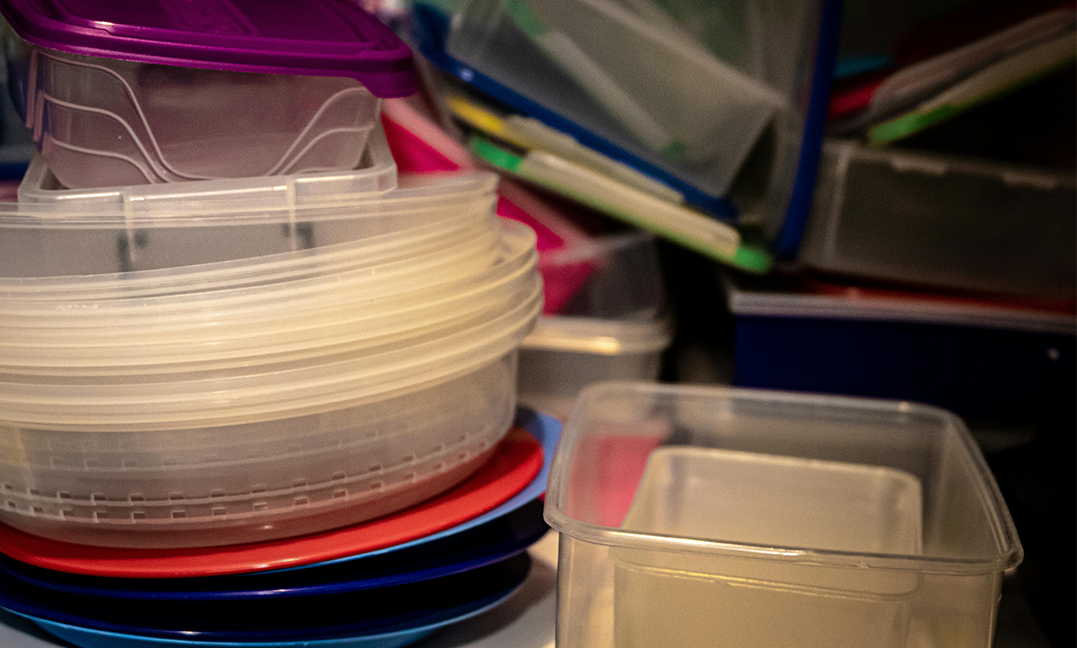
After finishing a tub of sour cream, yogurt, takeout, or lunch meat, resist the urge to classify the container as trash.
Wash it. Set it aside.
You have not had enough time to determine its future.
Gently squeeze the sides. If the container remains structurally sound, it is still good.
What it is good for is a separate question and does not need to be answered at this time.
A matching lid significantly increases a container’s value. If no matching lid can be found, retain the container temporarily.
The lid may still be in the dishwasher. Or another cabinet. Or somewhere you haven’t checked yet.
Containers without an immediate purpose should be classified as Pending Use.
Pending Use is not the same as unused. It means the container’s next assignment has not yet presented itself.
Do not rush this process.
Place smaller containers inside larger containers to reduce the apparent size of your collection. This is known as Provisional Nesting.
A properly nested collection can preserve dozens of containers while continuing to look like approximately seven.
Eventually, someone will hold up a container and ask: “Can I throw this away?”
Do not become defensive. Simply ask: “What’s wrong with it?”
This returns the burden of proof to the appropriate party.
Eventually, someone will need a container for leftovers, screws, craft supplies, bacon grease, or six cookies.
Retrieve the appropriate vessel. This moment is known as a Confirmed Save.
Do not say, “I told you so.”
You shouldn’t have to.
Not knowing what a container will be used for is not evidence that it won’t be used.
You just don’t know yet.
That’s why you have to keep it.