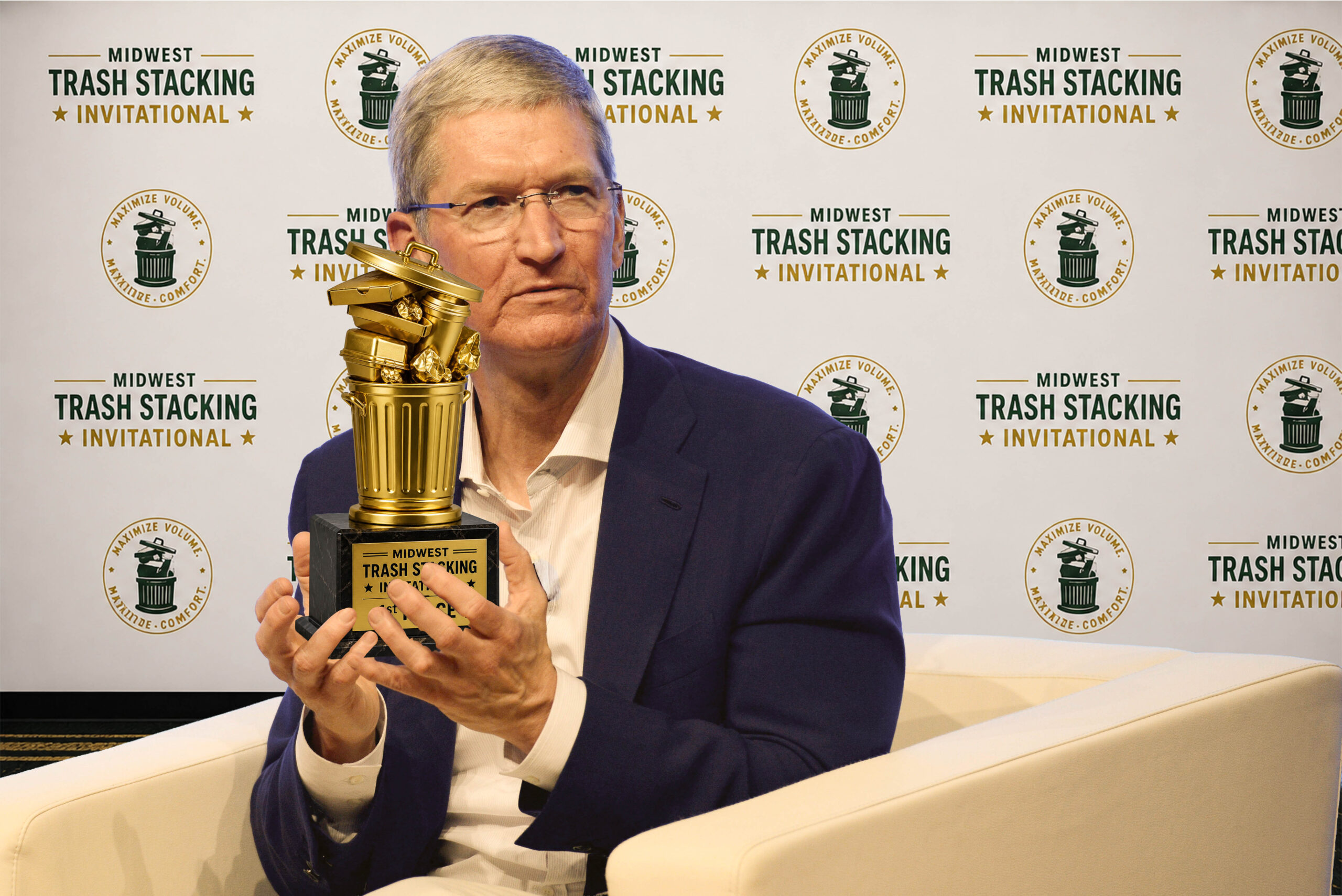
CINCINNATI — There was no announcement when he arrived.
No visible warm-up. No indication he was competing.
Just a full trash can in a standard residential kitchen—and Tim Cook standing nearby, holding what appeared to be a flattened takeout container with unusual intent.
By the end of the evening, officials had confirmed what few in attendance initially realized:
Cook had won the 2026 Midwest Trash Stacking Invitational.
Trash Stacking—sometimes referred to as Garbage Jenga—is a discipline defined not by output, but by restraint. Competitors attempt to extend the usable life of a full trash can without removing the bag, relying on balance, spatial awareness, and a willingness to delay resolution indefinitely.
Cook’s approach stood out immediately.
Rather than aggressively adding volume, he focused on compression efficiency—flattening materials, redistributing weight, and minimizing air gaps within the stack.
“It was systematic,” said one judge. “Every item had a purpose. Nothing felt… emotional.”
Midway through the event, Cook executed what analysts are calling a competition-shifting maneuver:
He paused.
Removed two items from the top layer.
Compressed them manually.
And reintroduced them at a lower structural tier.
The result was a measurable increase in stack stability and vertical capacity—without triggering collapse.
“It changed the geometry,” said one competitor. “Most of us are just reacting. He was designing.”
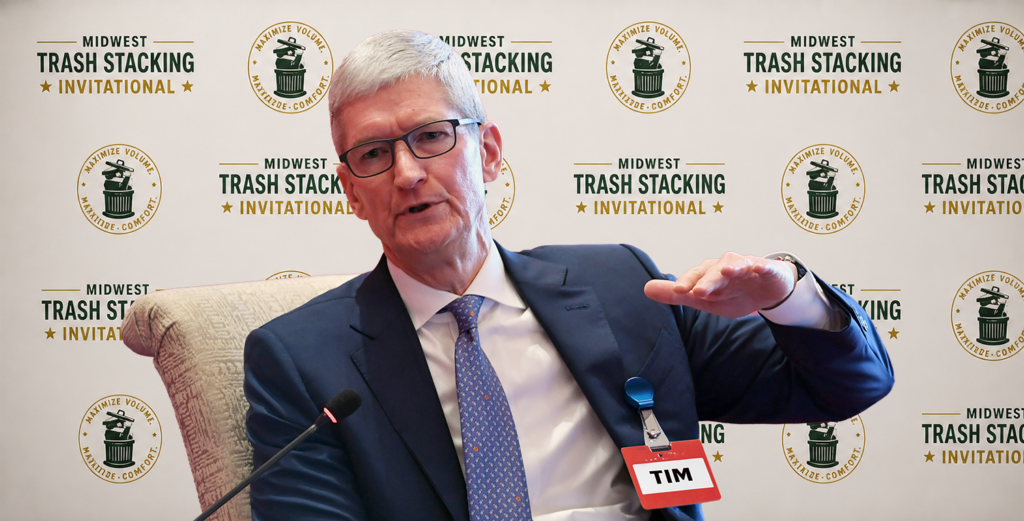
Tim Cook demonstrates his signature Horizontal Load Distribution Method, emphasizing a low, even layering strategy to delay structural consequences for as long as reasonably possible. “People rush the top,” he notes. “But true volume comes from respecting the sidewalls.”
While many competitors rely on instinct or avoidance, Cook’s performance suggested a more deliberate philosophy—one rooted in long-term optimization rather than short-term denial.
Observers noted:
At no point did he appear close to taking the trash out.
“That’s the hardest part,” said an event official. “Knowing you could resolve it—and choosing not to.”
This year’s Invitational featured a strong group of participants, including:
None matched Cook’s composure under pressure.
Unlike traditional athletes, elite Trash Stackers rarely follow formal training plans. Preparation tends to emerge naturally through daily repetition and incremental boundary testing.
Sources familiar with Cook’s habits describe a consistent pattern:
“He doesn’t think of it as practice,” one source said. “It’s just how he approaches problems.”
As participation in low-effort competitions continues to grow, performances like this are reshaping expectations around what success looks like.
Less reaction.
More intention.
Maximum volume, minimal intervention.
When reached for comment, Cook declined, stating only that he would “circle back later.”
For now, the structure remains.
Balanced.
Optimized.
Still not taken out.
If you’ve ever reorganized a full trash can to avoid dealing with it, this is a competition.
Midwest Trash Stacking Invitational
Location: Cincinnati, OH
Division: Residential / Open
Winning Duration: 6h 14m
Deciding Factor: Structural efficiency under sustained load